
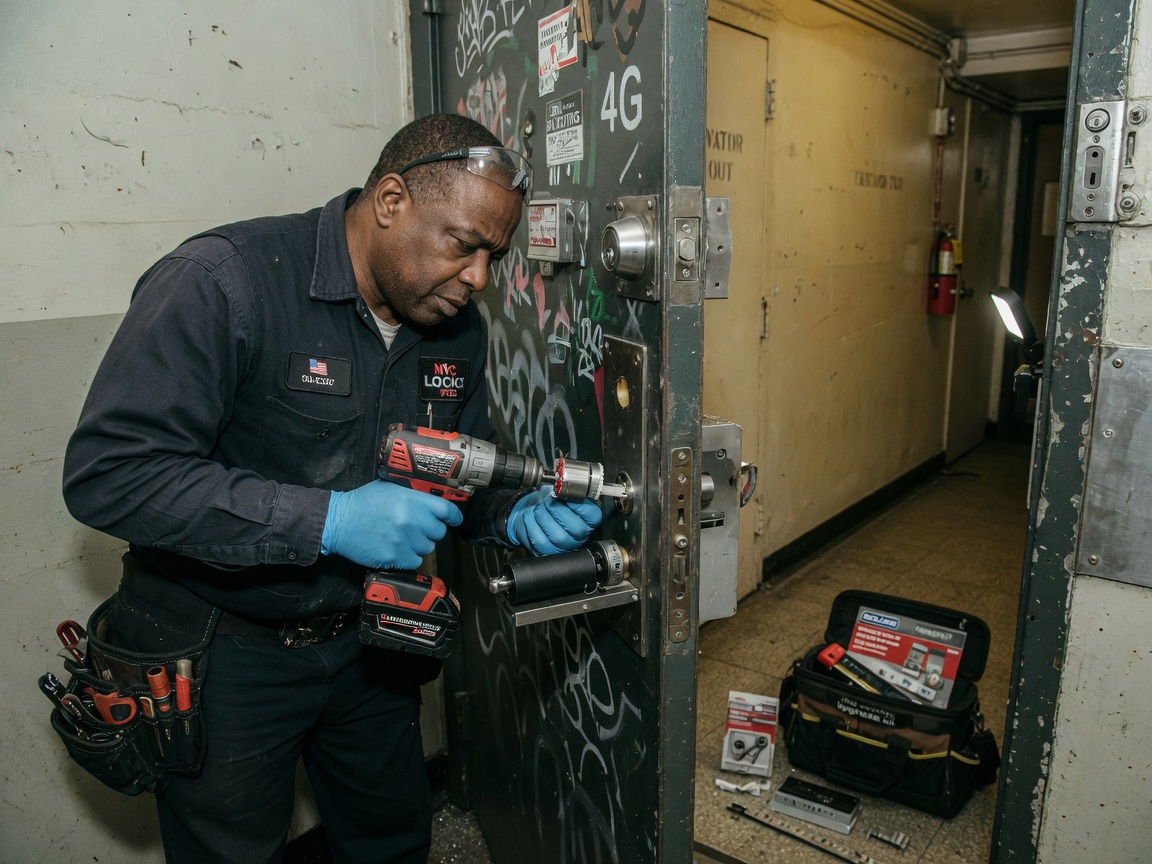
Manhattan's pre-war apartment buildings and brownstones in the Upper East Side often retain original mortise locks that no longer meet current security needs. These doors frequently sit in thick wood frames exposed to humid summers and freezing winters that cause swelling and contraction, loosening strike plates over time. A high-security upgrade typically involves replacing the cylinder with a grade-1 deadbolt rated for 1,000-pound kick-in resistance while preserving the historic hardware aesthetic demanded by co-op boards.
Central Park West and streets near the Empire State Building see frequent lockouts from failed night latches on steel-framed commercial entrances. In New York County, building codes require that any new lock allow single-motion egress, so we pair high-security cylinders with thumb-turn deadbolts rather than double-cylinder models. Humidity from the subtropical climate accelerates corrosion on brass components, making stainless-steel or nickel-plated options the practical choice for longevity.
Residents in nearby Brooklyn and the Bronx often request the same upgrades after break-ins involving bumped or drilled cylinders common in older stock. We evaluate door thickness, frame material, and existing hardware before recommending options such as restricted-key systems or electronic audit-trail locks that integrate with building management requirements without voiding insurance policies.
Technician insight
In New York the thing that catches most people out with High-Security Lock Upgrade is the variation in door thickness and frame material across pre-war buildings on the Upper East Side; a half-inch difference means the strike plate either bites solid wood or hits air, and winter contraction makes that gap widen.
Upper East Side brownstone upgrade
A resident called after a break-in attempt on a 1920s building near Central Park. The original mortise lock had been drilled. We found the frame had shifted from seasonal humidity. We installed a grade-1 deadbolt with a reinforced strike into solid oak blocking and re-keyed the remaining cylinders to a restricted system.
High-Security Lock Upgrade Services We Offer
✓Grade 1 Deadbolt Installation
Replaces weak latches with ANSI grade-1 deadbolts tested to 1,000-pound force, suited for thick pre-war Manhattan doors.
✓Restricted Key System Upgrade
Installs high-security cylinders that prevent unauthorized duplication, ideal for Upper East Side co-ops with multiple tenants.
✓Smart Lock Integration
Adds keyless entry with audit logs while maintaining single-motion egress required in New York County buildings.
✓Commercial High-Security Retrofit
Upgrades storefront and office locks near Times Square to resist forced entry common in high-traffic commercial zones.
✓Historic Hardware Preservation
Adapts modern high-security cylinders to vintage mortise locks without altering original appearance on landmarked properties.
High-Security Lock Upgrade Cost in New York
| Service | Typical Range | What Affects It |
|---|---|---|
| Residential deadbolt upgrade | $275–$450 | Depends on door thickness and whether historic hardware must be preserved |
| Restricted key system | $350–$600 | Higher when multiple cylinders or master-keying is required |
| Smart lock addition | $400–$750 | Includes integration with existing building systems |
| Commercial retrofit | $500–$900 | Steel frames and multiple points of entry increase scope |
Ranges are typical for New York and confirmed with an exact written quote before any work starts.
How it works
- 1
On-Site Evaluation
We inspect door thickness, frame condition, and existing hardware at your Manhattan location to identify compatibility issues.
- 2
Hardware Selection
Recommend cylinders and deadbolts rated for local climate exposure and building code compliance.
- 3
Installation
Remove old components, reinforce strike plates, and install new high-security hardware with proper alignment.
- 4
Testing And Handover
Verify smooth operation, provide new keys or codes, and explain maintenance for humid summers and cold winters.
Pricing
Pricing varies by door type and hardware grade; most Manhattan residential upgrades fall in the mid-hundreds.